
By Margie Carter & Diane Rawlins (JCIJ Accompaniment Volunteer), with support from Madison Indivisible
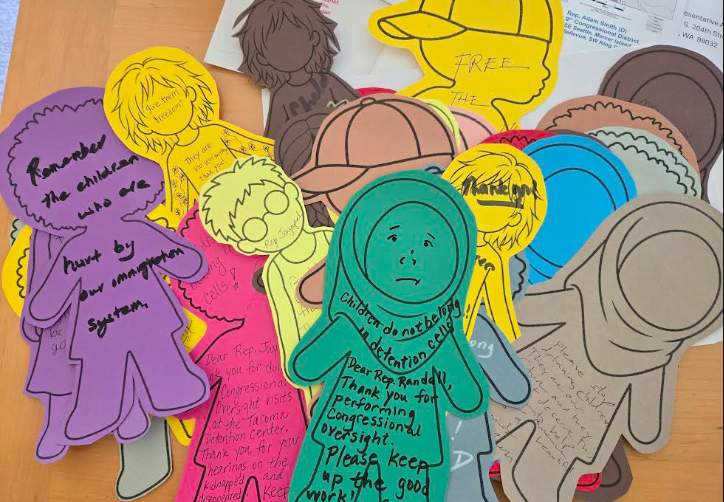
Compelling Messengers: Paper Dolls to Free Families
Celebrating the outcome of the midterm elections means claiming the power of everyday neighbors and activists to bring about change. The momentum created across the country has brought us a renewed sense of possibility as we press on with our work for Immigrant Justice.
Our stellar progressive Congresswoman Pramila Jayapal is planning an ambitious agenda for immigrant rights and government accountability. Her team needs the support of a strong public presence to educate, persist and insist on immigrant justice actions. As I write these words we learn ICE continues to escalate in the shadows of our communities. Immigrant children and families struggle to stay together, to meet basic needs, and to obtain release from detention centers.
I write to share the story of a promising campaign to aid in efforts to stop this nightmare. As you read on, consider how you might incorporate paper dolls to amplify your message about immigrant justice.
Created by Free Families: the National Coalition to End Family and Child Detention, Paper Dolls to Free Families is a national campaign inviting people from across the country, including educators and students, religious and community groups, and even children currently detained by ICE, to create paper dolls with messages and colors of hope, solidarity, and love. The campaign held a day of action in March 2026, delivering paper dolls to Congress with messages from children in detention as well as determined citizens demanding an end to the practice of family detention by cutting off funding for ICE and passing legislation such as the Dignity for Detained Immigrants Act. The work toward this goal continues.
In early summer 2026, a small ad hoc group of Seattle friends, loosely affiliated with Madison Indivisible, some active with JCIJ, learned about the use of paper dolls as a center-piece for immigrant support work from a church group in Arizona. This inspired us to create our own paper doll project, which we named “Help Write a Wrong.” We created a set of diverse paper doll templates and spent the summer displaying them at farmers’ markets and church social justice fairs, sharing the words of children in detention centers and asking people to take a stand by writing a message on a doll to their congress person about this heart-wrenching horror, which we then mailed to our representatives and senators.
A paper doll carries no weapon. It damages no property. It blocks no road. It cannot be called terrorism. What it carries is the handwriting of a neighbor or the words of a child asking to go home. Seven-year-old Mathias wrote “I cry a lot … I want to get out of here ... go back to my school … they don’t treat us well … we are kidnapped … help!” And twelve-year-old Edison shared, “I see how they treat us like criminals … and we’re not.”
Seeing the impact of these paper dolls as messengers motivated us to share our story and the materials we have developed. Our in-process, imperfect collection of resources includes the templates created for diverse images of dolls, recommended supplies, photographs, sample letters and flyers, which are available here. We offer these as tools for others to adapt in your own work, and encourage engagement with the National Coalition to End Family and Child Detention: Take Action - Free Families.
Our Seattle Paper Doll Project group has no aspiration or capacity to become our own organization but will take part in some of the coordinated calls for action of this national coalition. For now, we want to alert others to this creative and impactful tool that might be useful in activities you are undertaking to promote immigrant justice. We believe these paper dolls are compelling companions for advocates and activists to educate the general public, foster empathy and engage more voices for action; and to send to policy makers, state and federal legislators, with the power to stop this work of ICE and detention centers.
Members of our paper doll group contribute in different ways from donating supplies to cutting out dolls at home alone or with family members. A small group regularly gathers in a coffee shop, where we cut out printed paper doll images, discuss our experiences, review messages written on dolls, and divide up tasks for getting them mailed off with letters. Meeting in a public space generates bystander interest, questions, and more potential engagement.
For the No Kings-Vote Early Rally on October 16, 2026, we made smaller paper doll chain necklaces with simple words about voting, along with the desperate words of children in detention. We wore and handed them out throughout the event. For the January lobbying day in Olympia, we are imagining the hundreds of activists and advocacy teams wearing chains of paper dolls when they rally and meet with state representatives around Immigrant Justice issues.
What can you imagine? How might paper dolls amplify the message of your work to support Immigrant Justice?
Want to get involved with the Seattle Paper Doll Project? Check out their toolkit and email team@jewishcoalition.org with ‘Paper Doll Project’ in the subject line.